







📊 Quick Summary
- Topic: A strategic decision guide for foreign game studios and IT companies considering Türkiye
- Primary legislation: Presidential Decree No. 10962 (27 February 2026) + Türkiye Yüzyılı Tax Package (passed by Parliament on 21 May 2026)
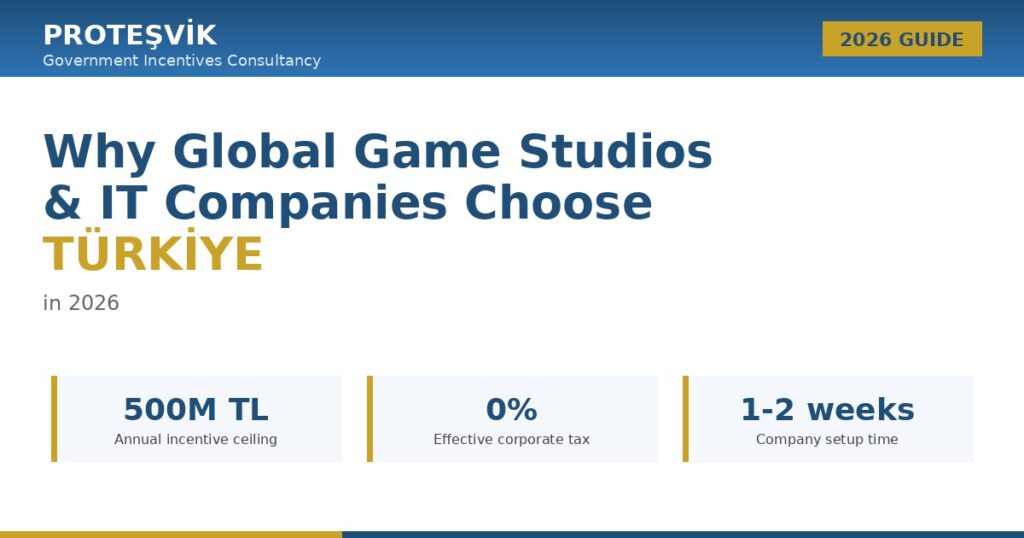
- Tax advantage: 0% effective corporate tax on service exports
- Incentive ceiling: Up to 500 million TL per year (E-TURQUALITY®)
- Day-one access: Services Sector Takeoff Program (no minimum company age)
- Company setup: 1-2 weeks when documentation is complete
- Minimum capital: 50,000 TL (~USD 1,110)
- 100% foreign ownership: Permitted, no Turkish partner requirement
- Location: Ankara, Istanbul, Izmir or any province — unrestricted
- Proteşvik service: Complimentary feasibility assessment + end-to-end management
Foreign IT companies in Türkiye — including international mobile gaming studios, SaaS firms, and IT services providers — face a substantially different picture in 2026 than just one year ago. Two regulatory moves — a comprehensive new incentive decree in February and a tax package passed by Parliament in May — have repositioned Türkiye in the regional decision matrix for global tech expansion. This guide explains, with concrete figures and three illustrative scenarios, why founders and CFOs from China, Taiwan, India, South Korea, the MENA region and beyond are increasingly putting Türkiye on the shortlist for foreign IT companies.
The 2026 Inflection Point: Three Regulatory Moves That Changed the Map
2026 is the year Türkiye’s position on the global technology incentive map shifted in a structural way. Three legislative developments came together:
- 27 February 2026 — Presidential Decree No. 10962 (Official Gazette No. 33181): consolidated all service export incentives for IT, gaming, and software into two cohesive tiers — the Services Sector Takeoff Program and the Branding Program (which includes the flagship E-TURQUALITY® track). The decree is in force from 1 January 2026.
- 21 May 2026 — Türkiye Yüzyılı Tax Package: the omnibus bill (record 2/3669) was passed by the Turkish Grand National Assembly. The provisions take effect retroactively from 1 January 2026 once published in the Official Gazette following presidential approval. The package brings the effective corporate tax on software and gaming service exports to 0%.
- Structural incentives: the R&D Law (5746), TÜBİTAK project grants, and the Investment Incentive Certificate system — fully accessible to foreign-owned Turkish entities.
The combined effect is a regional offering that was simply not on the table two years ago.
Four Strategic Reasons Foreign IT Companies Choose Türkiye
1. Effective 0% Corporate Tax on Service Exports
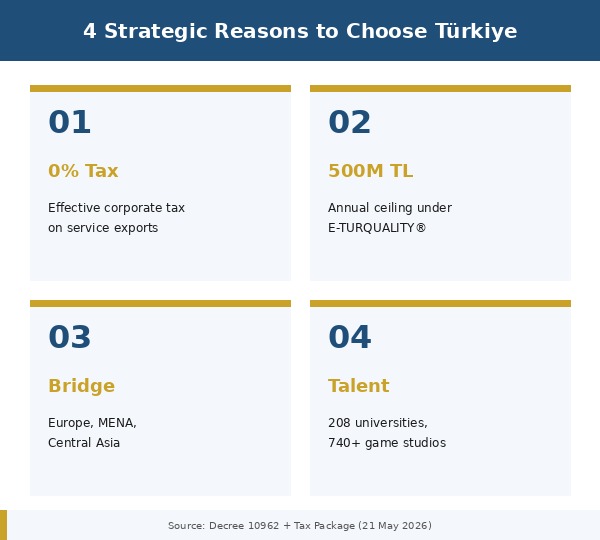
The tax package passed on 21 May 2026 amends Article 10/1-(ğ) of the Corporate Tax Code: the deduction rate on qualifying service export income — covering software, mobile games, engineering, architecture, design, call centers, and data analysis services — rises from 80% to 100%. The practical result is that effective corporate tax on these export revenues drops from 5% to 0%. The same package reduces the headline corporate tax rate for exporters from 20% to 14%, and to 9% for manufacturer-exporters.
To qualify, services must be invoiced to a non-resident customer and the foreign currency proceeds repatriated to Türkiye. Implementation takes effect from 1 January 2026 once the law is published in the Official Gazette following presidential approval. For a deeper breakdown of the package, see our Türkiye Yüzyılı tax package guide.
2. The Most Generous Tech Incentive Framework in the Region: Up to 500M TL Annually
Decree 10962 replaced the previous 5447 and 5448 framework with two clear tiers:
Tier 1 — Services Sector Takeoff Program (Day-One Access)
The Takeoff Program covers a wide range of expense categories directly relevant to gaming and IT operations. Among the most material items and their 2026 annual ceilings:
| Support Item | Annual Ceiling |
|---|---|
| Digital Product Promotion | 50,000,000 TL (up to 10 products, 15M TL per product) |
| Platform Commission (App Store, Google Play) | 20,000,000 TL |
| Data Center / Hosting | 5,000,000 TL |
| Software Licensing (Annex 31) | 2,500,000 TL |
| Database Membership (Annex 19) | 2,500,000 TL |
Beyond the items above, the Takeoff Program also covers overseas trademark, patent and intellectual property registration; market entry, certification and localization; overseas fair and event participation; strategic advisory; advisory for the acquisition of foreign companies, brands, software or platforms; domestic and overseas marketing personnel employment support; and Star Technology Office support for overseas offices, among other categories.
For the complete list of categories and current 2026 ceilings, see our 2026 IT services export incentives guide . The standard support rate is 50%, with a +20 percentage-point bonus for activities directed at designated target countries — bringing the effective rate to 70%.
Tier 2 — Branding Program (E-TURQUALITY®)
The upper tier carries an annual ceiling of 500,000,000 TL per brand over a five-year cycle, renewable based on performance. Three access paths exist:
- Standard path: three years of Turkish operations plus a minimum 70/100 score in the Ministry’s pre-assessment
- Fast-growth exception: two years of operations and USD 10 million in cumulative exports
- Acquisition or joint venture: entry via an existing qualifying Turkish entity
E-TURQUALITY® is not an automatic right — graduation depends on Ministry evaluation. Even if a company does not advance to the upper tier, the Takeoff Program continues to deliver tens of millions of TL in annual benefits as the primary support vehicle. For a fuller treatment, see our complete guide for foreign IT and gaming companies.
3. Geographic and Operational Bridge Position
Türkiye sits at the intersection of Europe, the Middle East, North Africa, and Central Asia. The UTC+3 time zone provides same-business-day overlap between Asian and European working hours — practical for daily coordination from Hong Kong, Singapore, Bangalore, or Seoul. Importantly for cost and talent decisions, the Turkish entity’s office location is unrestricted for Takeoff Program purposes: Ankara, Istanbul, Izmir, or any other province works equally well. The choice should follow talent access, operational preferences, and cost considerations rather than incentive eligibility.
4. Talent Pool and Ecosystem
- 208 higher education institutions (129 state universities, 75 foundation universities, 4 foundation vocational schools — source: Council of Higher Education, 2024-2025 data), producing a substantial annual STEM graduate pool.
- More than 740 active mobile game studios in Türkiye, with a market size of approximately USD 3.33 billion as of 2025.
- Peak Games (acquired by Zynga for USD 1.8 billion in 2020) and Dream Games (valued at approximately USD 2.75 billion) are among the well-known success stories.
- Developer compensation costs are materially competitive against Singapore, Berlin, or London at comparable seniority levels.
For founders specifically considering relocation from mainland China, our Türkiye relocation guide for Chinese mobile game studios covers the ecosystem dynamics in more detail.
Türkiye vs Singapore vs UAE vs Cyprus: A Strategic Comparison
For a foreign IT or gaming founder weighing options across jurisdictions, these are the headline parameters as of May 2026:
| Criterion | Türkiye | Singapore | UAE | Cyprus |
|---|---|---|---|---|
| Corporate tax on service exports | 0% (passed, awaiting publication) | 17% headline, 5-10% with incentives | 9% headline, 0% in free zones | 12.5% |
| LLC minimum capital | 50,000 TL (~USD 1,110)¹ | USD 1 | 0 (FZE) | EUR 1,000 |
| Setup time² | 1-2 weeks | 1-2 weeks | 2-3 weeks | 4-6 weeks |
| 100% foreign ownership | Permitted | Permitted | Permitted | Permitted |
| Mobile gaming ecosystem | Established (740+ studios) | Strong | Emerging | Limited |
| Annual incentive ceiling | 500M TL per brand (E-TURQUALITY) | Project-based | Free zone tax holidays | EU State Aid limits |
¹ At an approximate USD/TRY rate of 45.
² Assuming the company provides all required documentation in full; gaps extend the timeline.
The comparison reflects published headline figures and rules as of May 2026. Actual outcomes depend on company structure, sector, and revenue source. Independent local advice is recommended for each jurisdiction.
Three Illustrative Scenarios: How the Regulations Translate in Practice
Important note: The three scenarios below are fictional case studies created purely to make the regulatory framework concrete. Company names and financial figures are constructed for illustration. None represents an actual Proteşvik client, and these examples should not be read as outcome guarantees. USD/TRY conversions use a rate of 45.
Scenario 1 — DragonForge Studios (Fictional): A Chinese Mobile Game Studio
A 12-person mobile game studio based in Shanghai with annual revenue of approximately USD 2 million and USD 1.5 million in annual user acquisition (UA) spend. The founders establish a 100% Chinese-owned Turkish limited liability company (in Ankara or another province — the choice is operational, not regulatory). The Turkish entity registers with the Services Exporters Association (HİB).
Primary incentives utilized:
- Digital Product Promotion: a meaningful portion of UA spend qualifies for 50-70% reimbursement, within the 50M TL annual ceiling (≈ USD 1.1M), with a per-product cap of 15M TL
- Data Center / Hosting (5M TL ≈ USD 110K ceiling) — covering relevant AWS or Azure infrastructure costs
- Software Licensing — covering tools like Unity Pro, AppsFlyer, and analytics platforms
- Once the tax package is published, service export earnings benefit from the 0% effective corporate tax
Estimated annual net benefit: in the range of USD 700,000 — 1,000,000, depending on spend mix and the approval outcome.
Scenario 2 — DataPulse Analytics (Fictional): An Indian SaaS Company
A Series A SaaS company headquartered in Bengaluru with USD 5 million in annual recurring revenue, expanding into the EU and MENA markets. The founders establish a 100% Indian-owned Turkish LLC.
Primary incentives utilized:
- Database Membership (Annex 19): subscriptions to platforms such as Tableau, data.ai, and Mixpanel (annual ceiling 2.5M TL ≈ USD 55K)
- Software Licensing (Annex 31): HubSpot, Salesforce, Power BI and similar licenses (annual ceiling 2.5M TL ≈ USD 55K)
- Digital Product Promotion: marketing campaigns targeting EU and MENA (annual ceiling 50M TL ≈ USD 1.1M)
- 0% effective corporate tax on qualifying service export earnings
Estimated annual net benefit: in the range of USD 400,000 — 600,000; cumulative three-year benefit can reach USD 1.5-2 million.
Scenario 3 — TechFlow Solutions (Fictional): A Taiwanese IT Services Firm
A Taiwan-headquartered IT services firm with USD 50 million in annual revenue, an 80-person technical team, and an EMEA expansion plan. The Turkish entity is established in Ankara, with the local team growing to 25+ full-time engineers.
Beyond the Takeoff Program, optional headcount-linked paths are considered as the operation matures:
- R&D Center status (available when 15+ full-time R&D personnel are employed): payroll income tax withholding exemption on developer salaries, employer SGK premium support, and deduction of R&D expenditures from the corporate tax base
- TÜBİTAK project grants: project-based support applications as R&D activities formalize
- After three years of Turkish operations and on meeting Ministry criteria, E-TURQUALITY® graduation becomes possible (500M TL ≈ USD 11M annual ceiling)
Estimated annual net benefit: combining the Takeoff Program, R&D Center benefits, and eventual E-TURQUALITY graduation, the firm can reach USD 1 million and above annually.
The figures above represent upper-bound potential. Actual reimbursement depends on the spend mix, eligibility assessment, documentation quality, target market selection, and application timing. Each company’s circumstances differ.
Roadmap: The First 12 Months
Months 1-2: Strategic Assessment
Company profile, target market, and product/service portfolio analysis. Turkish entity decision (LLC for the standard case; joint stock company for larger structures). Office location is unrestricted — Ankara, Istanbul, Izmir, or another province all work equally well for Takeoff Program purposes.
Month 3: Turkish Entity Setup
Turkish LLC incorporation can be completed in 1-2 weeks when the company provides all required documentation in full. The minimum statutory capital is 50,000 TL (approximately USD 1,110 at a USD/TRY rate of 45). 100% foreign ownership is permitted; no Turkish partner is required.
Months 4-6: HİB Membership and First Takeoff Applications
Services Exporters Association (HİB) registration — a prerequisite for all Takeoff Program applications. Registration with the Support Management System (DYS). First application wave: Digital Product Promotion, Software Licensing (Annex 31), Database Membership (Annex 19), and hosting supports.
Months 7-12: Operations and First Reimbursements
Proper categorization and documentation of eligible expenses, and initial reimbursement claims. Local headcount is not a prerequisite — the Takeoff Program does not require Turkish hires to function.
Years 2-3: Optional Add-On Incentives as Operations Mature
If the company chooses to scale Turkish personnel or R&D operations, optional paths open up:
- Marketing and product development personnel employment supports (within the Takeoff Program framework)
- R&D Center status becomes available with 15+ full-time R&D personnel
- TÜBİTAK project grants as R&D activities take a formal structure
Year 3+: E-TURQUALITY® Evaluation Window
With three years of Turkish operations and a minimum 70/100 score in the Ministry’s pre-assessment, graduation to the Branding Program becomes possible. The graduation is not automatic and is subject to Ministry review.
Frequently Asked Questions
Is opening a branch office in Türkiye enough to access the incentives?
No. The supports under Decree 10962 require the beneficiary to be a company headquartered and operationally based in Türkiye, with operations that began in Türkiye. A branch of a foreign company does not meet this test. A separate Turkish legal entity (limited liability or joint stock) is required.
Is a Turkish co-shareholder required?
No. The Turkish LLC can be 100% foreign-owned; there is no local shareholder requirement.
Where should the Turkish office be located?
There is no location restriction for Takeoff Program purposes. Ankara, Istanbul, Izmir, or any other province can host the entity. The decision should follow talent access, cost, and operational preferences.
If the tax package has not been published in the Official Gazette yet, should we wait?
The Türkiye Yüzyılı Tax Package was passed by the Turkish Grand National Assembly on 21 May 2026 and takes effect retroactively from 1 January 2026 once published following presidential approval. Crucially, the support framework under Decree 10962 has been in force since 1 January 2026 — that side of the package does not require waiting.
Is only software supported?
No. Decree 10962 covers SaaS, mobile games, esports, fintech, blockchain, artificial intelligence, big data, cybersecurity, smart-city software, telecommunications, cloud services, data centers, IT services, and digital intermediation platforms.
Is local hiring mandatory? What personnel-related supports exist?
Local hiring is not a prerequisite for Takeoff Program access. That said, if a company chooses to hire, the Takeoff Program offers dedicated personnel employment supports for roles in marketing, business development, and digital product development:
| Personnel Location | Approximate Monthly Support |
|---|---|
| Personnel employed in Türkiye | ~90,000 TL / person-month |
| Personnel employed overseas | ~250,000 TL / person-month |
Up to five personnel may typically be claimed. As operations grow, companies reaching 15+ full-time R&D headcount can also evaluate R&D Center status — an optional path that unlocks payroll income tax withholding exemption, employer SGK premium support, and corporate tax deductibility of R&D expenditures. TÜBİTAK project grants can come into play as R&D activities formalize. These are optional add-ons; the Takeoff Program remains the primary support vehicle.
The personnel support figures above reflect current ceilings under the regulation. The Ministry updates ceilings annually based on the official revaluation rate. Net amounts and conditions depend on the company’s specific profile.
Do the support amounts lose value to inflation?
No. The Ministry of Trade updates annual support ceilings each calendar year using the official revaluation rate. This builds a structural inflation hedge into the program: the 50M TL, 500M TL, and other caps are not fixed in nominal terms — they reset each year. For long-term planning, the framework is inflation-protected.
Is upfront funding required?
No. Takeoff Program supports operate on a reimbursement basis against documented eligible expenses.
How long does company setup take?
Turkish LLC incorporation can be completed in 1-2 weeks when the company provides documentation in full. Gaps or errors in the documentation extend the timeline.
Is graduation from the Takeoff Program to E-TURQUALITY® guaranteed?
No. E-TURQUALITY® requires three years of Turkish operations plus a minimum 70/100 score in the Ministry’s pre-assessment. It is not automatic. Even without graduation, the Takeoff Program continues to deliver tens of millions of TL in annual benefits as the primary support vehicle.
Working with Proteşvik
Complimentary Feasibility Assessment
Proteşvik offers a complimentary feasibility assessment for foreign game studios and IT companies considering Türkiye. The assessment covers:
- Eligibility analysis against the current regulatory framework
- Indicative annual support potential and timeline
- Strategic recommendations on Turkish entity structure
- A concrete 12-month operational roadmap
End-to-End Engagement — Five Phases
- Eligibility assessment and roadmap design (complimentary feasibility)
- Pre-incorporation structuring support
- Application preparation and submission
- Ongoing documentation and expense tracking through the DYS system
- Reimbursement follow-up and file management
With more than 15 years of hands-on experience navigating Türkiye’s incentive ecosystem, our consultants translate the regulatory framework into operational outcomes. For the full scope of our work, see our consultancy services overview.
Foreign IT Companies in Türkiye: The 2026 Strategic Window
Decree 10962 has consolidated and clarified Türkiye’s IT and gaming support architecture, while the tax package passed on 21 May 2026 brings the effective corporate tax on qualifying service exports to 0%. Combined, these two moves create a decision matrix for foreign game studios and IT companies that genuinely competes with Singapore, Dubai, and the major EU jurisdictions.
The structural opportunity is real, but execution depends on entering Türkiye with the right entity structure, the right timing, and a clear plan. Our complimentary feasibility assessment exists to clarify exactly those three questions for your specific case.
Official references:
- Ministry of Trade — Services Sector Supports
- Ministry of Trade — Export Supports
- Support Management System (DYS)
- Invest in Türkiye (official investment agency)
See Your Türkiye Potential Before You Incorporate
A 30-minute complimentary feasibility assessment will clarify your eligibility, indicative annual support potential, and a concrete 12-month roadmap tailored to your company.
📞 +90 (530) 160 10 65
✉️ [email protected]
💬 WhatsApp: wa.me/905301601065