







📊 Quick Summary
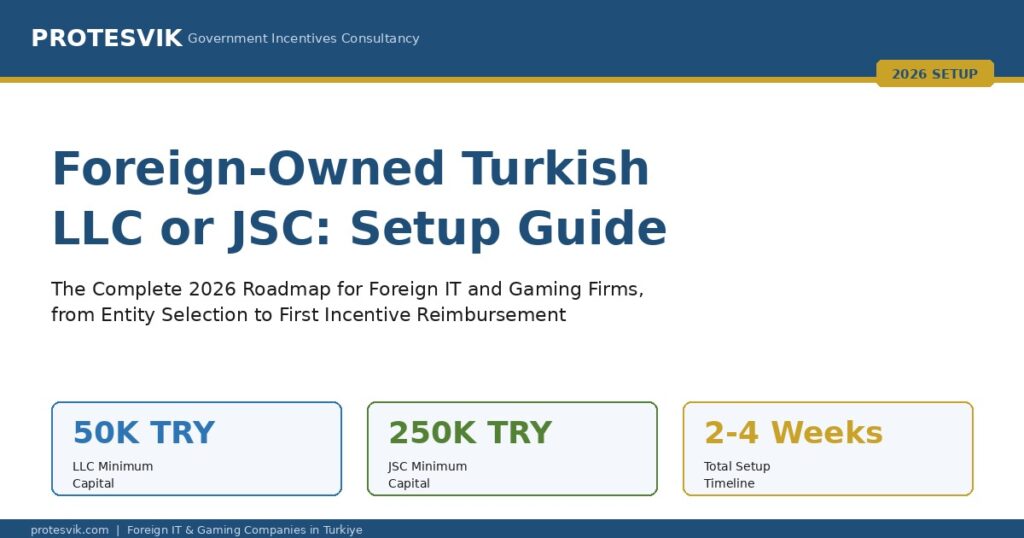
- Two main options: Limited Liability Company (50,000 TRY minimum capital) or Joint Stock Company (250,000 TRY minimum capital)
- Legal anchor: Turkish Commercial Code No. 6102 (TCC) and Foreign Direct Investment Law No. 4875
- 100% foreign ownership permitted; no Turkish co-shareholder required (equal treatment principle under Law No. 4875)
- Setup time: Trade registry registration in 24–72 hours once documents are ready; total process 2–4 weeks
- Capital payment: Joint Stock Company requires 25% blocked at the bank before registration (TCC Art. 344); Limited Liability Company has no such requirement, with capital payable within 24 months
- Competition Authority share: 0.04% of capital, paid at incorporation
- Authorized capital system (private joint stock): initial capital 500,000 TRY
- Capital adjustment deadline: 31 December 2026 for existing under-capitalized companies
- Proteşvik service: end-to-end advisory for foreign IT and gaming firms to access Türkiye’s export incentive ecosystem, from incorporation through incentive activation
A foreign owned Turkish LLC is the most accessible legal structure for foreign IT and gaming firms entering the Türkiye market in 2026. For founders weighing entity options, the choice typically narrows to two: a foreign owned Turkish LLC (50,000 TRY minimum capital) or a Joint Stock Company (250,000 TRY minimum capital). Both routes open access to the service export incentives (Presidential Decree No. 10962), the 0% effective corporate tax (Law No. 7582), and the marketing personnel subsidy. A branch or liaison office is not sufficient for the majority of these supports.
This foreign owned Turkish LLC and JSC setup guide walks through every step under the Turkish Commercial Code No. 6102 (TCC) and the Foreign Direct Investment Law No. 4875. Every figure is verified against the 2026 legislation.
Step 1 — Choosing the Right Entity Type: LLC or JSC?
Under Foreign Direct Investment Law No. 4875, foreign investors hold the same rights as domestic investors. Every entity form permitted by the Turkish Commercial Code is open to foreign founders, but two structures dominate the choice for technology and service-export businesses.
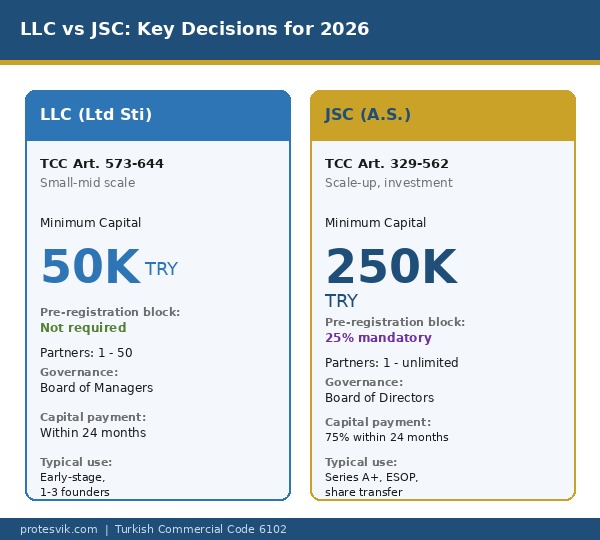
Limited Liability Company (Ltd Şti) — TCC Articles 573–644
- Minimum capital: 50,000 TRY
- Number of partners: minimum 1, maximum 50
- Capital payment: no requirement to block cash at the bank before registration. Subscribed capital is payable within 24 months.
- May be incorporated with a single partner (TCC Art. 573)
- Governance: board of managers
Joint Stock Company (A.Ş.) — TCC Articles 329–562
- Minimum capital: 250,000 TRY
- Authorized capital system (private joint stock): initial capital of 500,000 TRY
- Capital payment: at least 25% of cash capital blocked at the bank before registration (TCC Art. 344). The remaining 75% is payable within two years.
- May be incorporated with a single shareholder (TCC Art. 338)
- Governance: board of directors
- Contracted attorney requirement: mandatory for JSCs with capital of 1,250,000 TRY and above (Attorneys Act No. 1136, Art. 35)
Which One Fits Your Case?
LLC is typically the right choice when:
- The plan is a small-to-mid scale operation (under 5 million TRY annual turnover expected)
- Founding partners number between 1 and 3
- No IPO is planned
- A lower starting capital is preferred
JSC is typically the right choice when:
- An investment round (Series A and above) is on the roadmap and share transfer flexibility matters
- An employee stock option plan (ESOP) is planned
- A future IPO is on the table
- A multi-shareholder or institutional investor structure is anticipated
- The entity will sit inside a holding structure
An LLC can later be converted into a JSC (TCC Art. 180–194), but the conversion costs time and money. Long-term plans are worth weighing at the incorporation stage.
Step 2 — Pre-Incorporation Preparation and Documents
For a foreign individual or corporate founder, document preparation is the most critical phase. Incomplete preparation typically extends the timeline by 2–3 weeks.
Documents for a Foreign Individual Partner
- Passport copy: notarized and apostilled in the country of origin (for Hague Convention member states), then translated into Turkish by a sworn translator and notarized in Türkiye
- Potential tax identification number: obtained through the Turkish Revenue Administration’s digital platform for foreigners
- Signature declaration: drawn up before the Trade Registry Office or a notary
- Photographs (2 copies)
- Address declaration
Documents for a Foreign Corporate Partner
- Certificate of activity: issued in the country of origin, apostilled (or consularized by a Turkish consulate if the country is not party to the Hague Convention), translated into Turkish and notarized
- Resolution to participate: adopted by the foreign entity’s competent body, apostilled and translated
- Documents for the corporate representative: passport or ID translation
- Signature circular or proxy
A Note on Apostille
Türkiye is a party to the Hague Apostille Convention. Documents issued in member states (the United States, EU countries, the UAE, Singapore, Japan, India and others) acquire validity through the apostille certification. For documents from non-member states (for example, the People’s Republic of China) the Turkish consulate in the country of origin must legalize them.
This sequence is the most variable part of the overall setup calendar. Overseas document procurement typically takes 2–4 weeks.
Step 3 — Potential Tax Number and MERSIS Registration
Potential Tax Identification Number
Foreign individuals can apply online through the Turkish Revenue Administration’s interactive tax office portal for foreigners. Foreign corporate entities apply in person at the relevant tax office.
This number must be in hand before incorporation, because MERSIS registration, bank account opening, and every official filing depend on it.
MERSIS — The Central Registry System
MERSIS is Türkiye’s central system for all commercial records. Before incorporation steps begin, every individual or corporate partner must be registered in MERSIS and assigned a MERSIS number.
The main actions handled through MERSIS:
- Trade name reservation: confirming the desired company name is available
- Drafting the articles of association: legally required to be in Turkish, prepared electronically
- Defining the shareholding structure: capital shares and commitments of each partner
- Setting the scope of activity: NACE code selection
- Appointing the authorized manager / board of directors
NACE code selection is a defining decision for foreign IT and gaming firms. The codes most commonly used in the IT sector are 62.01 (computer programming activities), 62.02 (IT consultancy), 62.09 (other IT services), and 63.11 (data processing, hosting and related activities). An incorrect NACE choice can create eligibility problems later, when export incentives are assessed. For a deeper view, see our guide for foreign game studios and IT companies in Türkiye.
Step 4 — Articles of Association, Bank Account, and Capital Payment
Articles of Association
The articles are prepared through MERSIS and must be in Turkish by law. An informational translation can be arranged for the foreign founder, but the legally binding text is the Turkish version. Mandatory contents include:
- Trade name of the company
- Registered office address
- Scope of activity and NACE code
- Capital amount and share structure
- Each partner’s name/title, nationality, and tax number
- Governance structure (board of managers for an LLC, board of directors for a JSC)
- Term of the company
The articles are signed either before a notary or before an authorized officer at the Trade Registry Office. Execution under a power of attorney is also possible; the proxy must be notarized and apostilled.
Bank Account and Capital Deposit
A bank account is opened in the company’s name. For a Joint Stock Company, at least 25% of the cash capital is blocked at the bank before registration (TCC Art. 344). The bank issues a letter confirming this. For a Limited Liability Company there is no such requirement; the capital is payable within 24 months.
Competition Authority Share
Before registration, 0.04% of the capital is paid to the Competition Authority through the Chamber of Commerce cashier. For example, on a JSC with 250,000 TRY capital, this amounts to 100 TRY.
Step 5 — Trade Registry Registration
Once the documents are in order, the foreign owned Turkish LLC or JSC registration application is filed with the local Trade Registry Office. With a complete and correct file, registration is completed within 24–72 hours.
The Trade Registry Office completes the registration, the company acquires legal personality, and the incorporation is announced in the Turkish Trade Registry Gazette. The registration is then transmitted automatically to the tax office and the Social Security Institution.
Following registration, the company’s MERSIS number, trade registry number, and tax identification number are finalized. The entity can begin commercial activity from that point.
Step 6 — Tax Office, Social Security, and Operational Setup
Post-registration items include:
- Tax office activation: transmitted automatically by the Trade Registry; a tax inspection follows
- Books of account legalization: journal, general ledger, inventory book (a JSC additionally needs a share ledger, board of directors resolution book, and general assembly book)
- Social security employer file: required if personnel will be hired
- Electronic signature (e-imza) and KEP (registered electronic mail): mandatory for E-Invoice, e-TUYS, and DYS (Support Management System)
- E-Invoice obligation: triggered by turnover thresholds or sectoral requirements
This is the stage where the foundation for export-incentive applications is built. For service exporters, a critical step is membership in the Services Exporters Association (HİB), a prerequisite for all Atılım Program supports under Presidential Decree No. 10962. For the full scope of the Atılım Program, see our analysis of the Türkiye tax reform and personnel subsidy framework.
Comparison Table — Foreign Owned Turkish LLC vs JSC (2026)
| Criterion | Limited Liability Company (Ltd Şti) | Joint Stock Company (A.Ş.) |
|---|---|---|
| Minimum capital | 50,000 TRY | 250,000 TRY (authorized capital system: 500,000 TRY) |
| Cash deposit before registration | Not required | 25% mandatory block (TCC Art. 344) |
| Number of partners | 1 – 50 | 1 – unlimited |
| Governance | Board of managers | Board of directors |
| Share transfer | Notary + registration required | More flexible (especially for registered shares) |
| IPO option | Not possible | Possible |
| Contracted attorney | Not required | Mandatory at 1,250,000 TRY+ capital |
| Corporate tax | 25% (standard) | 25% (standard) |
| Typical use case | Small to mid-scale | Scale-up, investment-bound, ESOP-planned |
Corporate tax rates are identical between the two structures. Choosing LLC over JSC does not produce a tax advantage; the choice is based on capital structure, ownership flexibility, and growth plans. As of 2026, for software and gaming service exports the effective corporate tax is 0% for both structures (Law No. 7582, Corporate Tax Code Article 10/1-(ğ)). For the conditions and effect of this exemption, see our analysis of the Türkiye tax reform and 70% personnel subsidy; for the full service-export incentive framework, see our complete state incentive ecosystem guide for foreign IT and gaming companies.
Important Notes for Foreign Owned Turkish LLC and JSC Investors
Work Permit Requirements
- Joint Stock Company board members not resident in Türkiye do not need a work permit
- Limited Liability Company partners who are not company officers also do not need a work permit
- A foreign officer (manager / board member) who will actively work in Türkiye does need a work permit
Branch and Liaison Office Alternatives
- Branch: an extension of the foreign company in Türkiye, without a separate legal personality. Access to most export incentives is limited.
- Liaison office: representation only, with no commercial activity allowed. Not eligible for incentives.
- New Turkish entity (LLC or JSC): a fully separate legal personality, 100% foreign ownership permitted. Full access to incentives.
For foreign IT and gaming firms aiming to use export incentives (e-Turquality, the Atılım Program) and the 0% effective corporate tax, the new Turkish LLC or JSC is the preferred structure.
Frequently Asked Questions
Can a single foreign individual incorporate a foreign owned Turkish LLC?
Yes. Under TCC Article 573, an LLC can be formed by a single partner. Foreign investors hold equal rights to domestic investors under Law No. 4875; 100% foreign ownership is permitted and no Turkish co-shareholder is required.
Is it necessary to travel to Türkiye to incorporate?
No. With a power of attorney (apostilled and translated into Turkish abroad) the entire process can be handled through a proxy. Passport translation, MERSIS procedures, articles of association signing, and the registration application can all be performed by a proxy.
Is incorporation really completed in 1–2 weeks?
The Trade Registry step itself runs in 24–72 hours once the documents are ready. The 2–4 week range is set by the upstream document chain: apostilled certificates of activity, resolutions, and passport documents typically take 2–4 weeks to procure overseas. Running these streams in parallel keeps the realistic total to 2–4 weeks.
Do I need to pay the full minimum capital at incorporation?
No. In an LLC the capital is committed at incorporation, with no cash-block requirement, and it is payable within 24 months. In a JSC at least 25% of the cash capital is blocked at the bank before registration, and the remaining 75% is payable within two years (TCC Art. 344).
Why establish a separate Turkish entity rather than a branch or liaison office?
Türkiye’s export incentive architecture (e-Turquality, the Atılım Program, the 0% effective tax) requires a Türkiye-headquartered legal entity. A branch or liaison office is not sufficient for most of these supports. For a deep dive on how foreign AI firms structure this, see our guide on how foreign AI companies access Türkiye’s incentive stack in 2026.
Can capital be increased later?
Yes. Both LLCs and JSCs can increase capital at any time. In an LLC, the partners’ assembly takes the decision; in a JSC, the general assembly does. The increase is then registered with the Trade Registry. This means a foreign investor can start lean and scale capital as the entity grows.
My existing entity has capital below 50,000 TRY — what should I do?
Under TCC Provisional Article 15, added by Presidential Decree No. 7887 and Law No. 7511, existing companies with capital below the new minimums must increase their capital by 31 December 2026. Companies that do not complete the increase by that date are deemed dissolved. For newly incorporated entities this question does not arise: the new company is set up directly at the current minimum-capital level.
How Proteşvik Helps
Proteşvik’s core mission is to help foreign IT, gaming, and technology firms access Türkiye’s export incentive ecosystem. End-to-end company setup advisory falls inside this remit, because the choice of entity type, NACE code, articles of association language, and capital structure directly determines incentive eligibility down the line.
Our work covers:
- Incentive-aligned entity choice: LLC or JSC recommendation in light of the targeted supports
- NACE code selection: the right coding to access the relevant Decree No. 10962 and e-Turquality support items
- Document preparation and apostille management: coordination and tracking of overseas documentation
- Articles of association drafting: language aligned with the targeted incentive legislation
- Coordination of MERSIS, bank, Trade Registry, and tax office processes
- Post-incorporation packages: e-signature, KEP, HİB membership, DYS activation, initial accounting setup
- Transition to incentive applications: Atılım Program, e-Turquality, 0% tax exemption activation, and management of the first reimbursement cycle
With more than 15 years of hands-on experience in Türkiye’s incentive ecosystem, we run the entire journey from the entry decision to the first reimbursement under one roof for the foreign investor.
Official references:
- Resmî Gazete (Official Gazette of Türkiye)
- Ministry of Trade
- MERSIS — Central Registry System
- Turkish Revenue Administration
- Invest in Türkiye
See Your Türkiye Potential Before You Incorporate
A 30-minute complimentary feasibility assessment will clarify how your Turkish LLC or JSC setup aligns with the incentive legislation, provide a NACE code recommendation, and lay out a concrete 12-month roadmap tailored to your company.
Request Feasibility Assessment →
📞 +90 (530) 160 10 65 | ✉️ [email protected] | 💬 WhatsApp