







Quick Summary
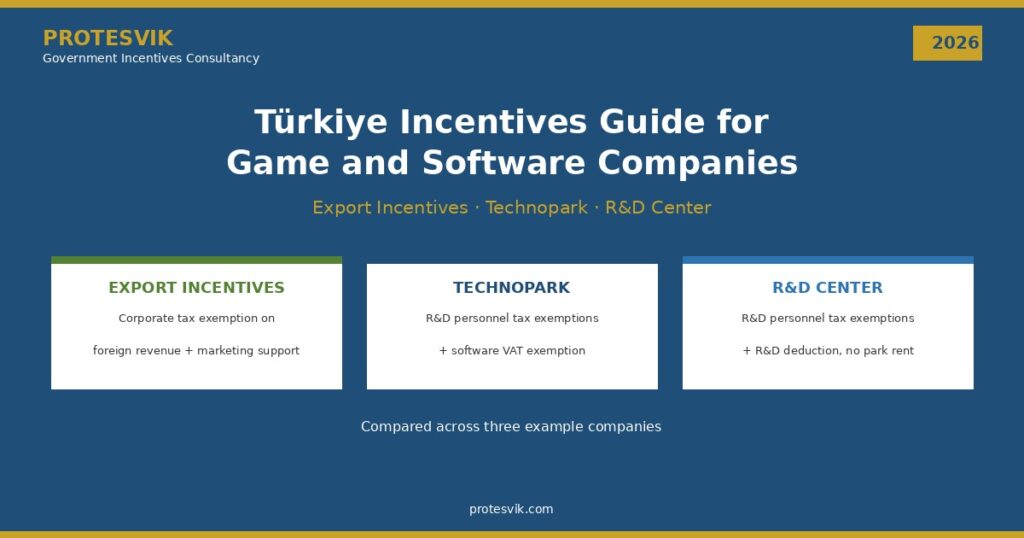
- Türkiye offers several distinct incentive structures for game and software companies: export incentives, the technopark (Law No. 4691) and the R&D Center (Law No. 5746).
- For companies selling software and games abroad, the most direct gain comes from export incentives; these operate independently of a company’s R&D structure.
- Export incentives cover user acquisition advertising, platform commissions, marketing, software licenses, hosting and overseas office costs at 50% (up to 70% in target countries), plus a corporate tax exemption on foreign sales revenue.
- To reduce the tax cost of R&D personnel, two structures stand out: the technopark and the R&D Center.
- The technopark provides income tax withholding, social security employer share, corporate tax and value added tax exemptions; in return it requires a physical office and rent within the zone.
- The R&D Center provides similar personnel advantages at the company’s own premises with no zone rent; however it requires at least 15 full-time-equivalent R&D staff and uses a different tax mechanism (R&D deduction).
- In the technopark, software sales are exempt from value added tax; the R&D Center has no such exemption.
- Which structure is more advantageous depends on the company’s software revenue, profit, R&D expenditure and office cost; there is no single answer, and a feasibility study is required.
- The remote work ratio for information-technology personnel is applied at 100% and renewed periodically; the current arrangement is valid until 31 December 2026.
- Foreign game and information-technology companies can access all three incentive areas through a company they establish in Türkiye.
All figures in this article use an exchange rate of 1 US Dollar = 48 Turkish Lira.
Introduction
Türkiye software incentives come in several forms, and a game or software company operating in Türkiye can benefit from more than one incentive area. This article covers three of them: export incentives for companies selling abroad, and the technopark and R&D Center structures that lower the tax cost of R&D personnel. It gives priority to the direct gains that export incentives offer to companies selling software and games abroad; it then compares the technopark and the R&D Center numerically across three example firms.
All figures in the comparison rest on specific assumptions, such as a gross monthly personnel cost of 100,000 Turkish Lira (about 2,083 US Dollars) per person, and are illustrative. The aim is to show which structure stands out for which company profile; a firm-specific result is determined by a feasibility study using real figures.
Abbreviations
- R&D: Research and Development
- VAT: Value Added Tax
- m²: Square metre
Export Incentives: For Companies Selling Abroad
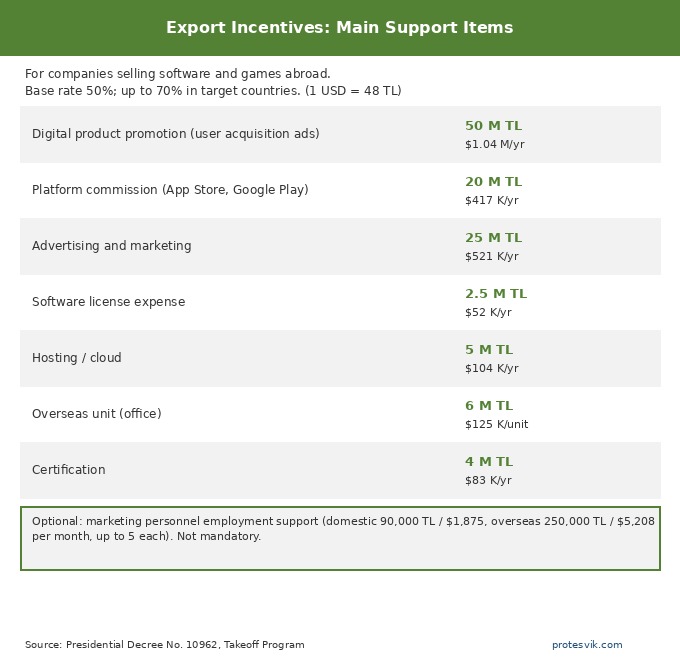 For a company selling software and games abroad, the most direct gain comes from export incentives. These supports target the cost of foreign sales and growth rather than R&D cost, and operate entirely independently of the technopark or R&D Center structure. The current framework was set by Presidential Decree No. 10962; we covered all the items and limits of the information-technology service export supports in a separate article.
The core of the export incentives consists of expense items that directly lower foreign sales and growth cost. The main items and their 2026 ceilings are as follows: digital product promotion (user acquisition advertising) at 50% and up to 50 million Turkish Lira (about 1.04 million US Dollars) per year; platform commission (the commissions charged by stores such as the App Store and Google Play) at 50% and 20 million Turkish Lira (about 417,000 US Dollars) per year; advertising and marketing at 50% (70% in target countries) and 25 million Turkish Lira (about 521,000 US Dollars) per year; software license expense at 50-70% and 2.5 million Turkish Lira (about 52,000 US Dollars) per year; hosting and cloud at 50-70% and 5 million Turkish Lira (about 104,000 US Dollars) per year; overseas unit (office) expense at 50-70% and 6 million Turkish Lira (about 125,000 US Dollars) per unit; and certification at 50% and 4 million Turkish Lira (about 83,000 US Dollars) per year. In addition, a corporate tax exemption applies to foreign sales revenue.
These items directly target a company’s largest growth expenses, particularly the user acquisition (advertising) budget. For example, a game company spending 10 million Turkish Lira on user acquisition advertising in foreign markets can recover 50% of this spend, and 70% in target countries. For companies of all sizes, export incentives are independent of the R&D structure decision and are generally the largest gain area.
Alongside these, there is an optional item: employment support for marketing and sales personnel. Employing personnel is not mandatory; however, if the company employs personnel for international marketing, support is provided at 50% over a monthly ceiling of 90,000 Turkish Lira (about 1,875 US Dollars) for domestic personnel and 250,000 Turkish Lira (about 5,208 US Dollars) for personnel at overseas units, for up to 5 people each. This support is only for marketing and sales personnel; software or game developer personnel are not within this scope.
Tax Structures for R&D Personnel: Technopark and R&D Center
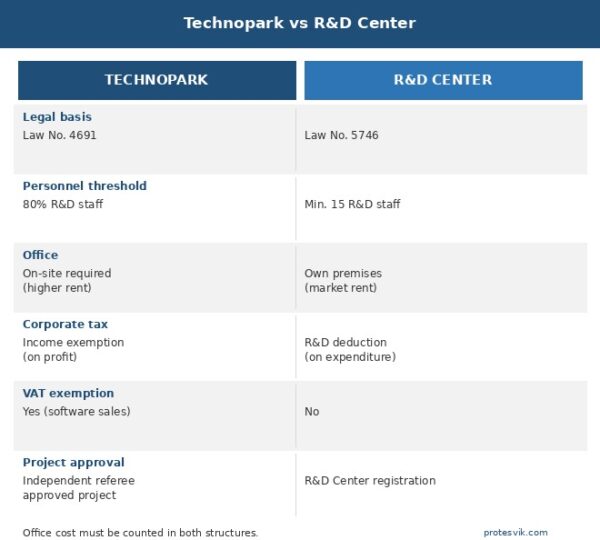
While export incentives support the sales side, two main structures stand out for reducing the tax and premium cost of R&D personnel: the technopark and the R&D Center. Both offer similar personnel advantages on the income tax withholding, social security employer share and stamp duty side; the key differences appear in the office, the corporate tax mechanism and the VAT exemption.
The technopark, under Law No. 4691, requires a physical office within the zone, and software sales are exempt from VAT; the profit earned from software projects carried out in the zone is exempt from corporate tax. The R&D Center, under Law No. 5746, is established at the company’s own premises and requires at least 15 R&D personnel; its corporate tax advantage takes the form of an R&D deduction rather than an income exemption, meaning the full R&D expenditure is deducted from the tax base. The R&D Center does not have the technopark’s VAT exemption. We covered the R&D Center’s requirements and cost details in a separate article.
Let us make the per-person personnel advantage concrete. For an R&D employee with a gross monthly cost of 100,000 Turkish Lira, the total of the income tax withholding exemption, social security employer support and stamp duty exemption is around 227,000 Turkish Lira (about 4,700 US Dollars) per year in both structures. This amount grows in direct proportion to the number of personnel.
Numerical Comparison Across Three Example Companies
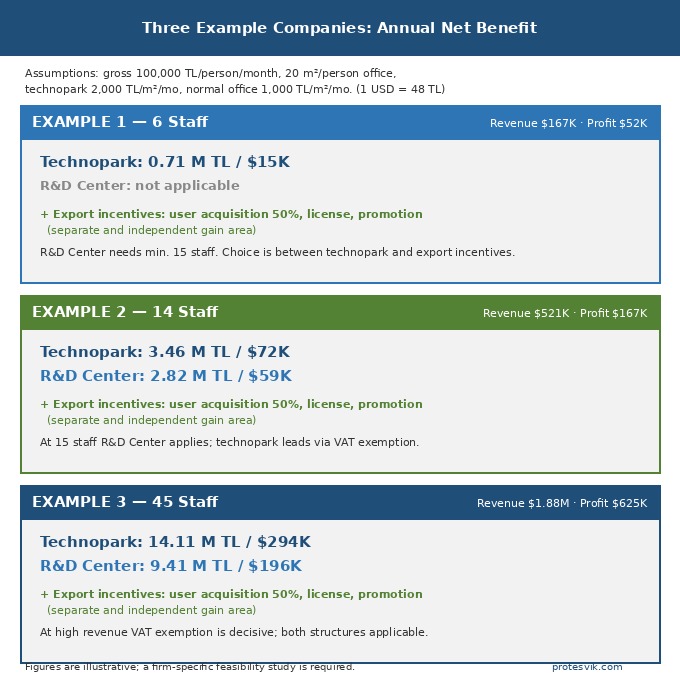
The three examples below represent scales that game and software companies frequently encounter. Common assumptions: gross monthly personnel cost of 100,000 Turkish Lira per person; 20 m² of office area per person (including workspace plus a share of common areas such as meeting room, kitchen and corridor); technopark rent of 2,000 Turkish Lira/m²/month (VAT included, technopark premium); normal commercial office rent of 1,000 Turkish Lira/m²/month (a default value that varies by region, ownership and location). The corporate tax rate is taken as 25% and VAT as 20%. Figures are illustrative.
Example 1 — Game Studio with 6 R&D Staff
Assumptions: annual software revenue 8 million Turkish Lira (about 167,000 US Dollars), annual profit 2.5 million Turkish Lira (about 52,000 US Dollars), annual R&D expenditure 4 million Turkish Lira.
| Item | Technopark | R&D Center |
|---|---|---|
| Personnel advantage (income tax withholding + social security + stamp duty) | +1.36 M TL | — |
| Corporate tax (Technopark: profit × 25% exemption) | +0.63 M TL | — |
| VAT exemption (software revenue × 20%) | +1.60 M TL | — |
| Office rent (technopark 2,000 TL/m²) | −2.88 M TL | — |
| Annual net benefit | +0.71 M TL / $15K | Not applicable |
At this scale the R&D Center is not an option, because it requires at least 15 full-time-equivalent R&D personnel and a 6-person company does not meet this threshold. The company’s decision is therefore between the technopark and export incentives. The technopark provides a net contribution of about 0.71 million Turkish Lira (about 15,000 US Dollars) per year at this scale; the main gain, however, comes from export incentives on foreign sales. For this company, 50-70% of user acquisition advertising, software license and promotion expenses is a gain area that is independent of the technopark decision and generally larger.
Example 2 — Software Firm with 14 R&D Staff
Assumptions: annual software revenue 25 million Turkish Lira (about 521,000 US Dollars), annual profit 8 million Turkish Lira (about 167,000 US Dollars), annual R&D expenditure 12 million Turkish Lira.
| Item | Technopark | R&D Center |
|---|---|---|
| Personnel advantage (income tax withholding + social security + stamp duty) | +3.18 M TL | +3.18 M TL |
| Corporate tax (Technopark: profit × 25% / R&D Center: expenditure × 25%) | +2.00 M TL | +3.00 M TL |
| VAT exemption (software revenue × 20%) | +5.00 M TL | — |
| Office rent | −6.72 M TL | −3.36 M TL |
| Annual net benefit | +3.46 M TL / $72K | +2.82 M TL / $59K |
At 14 staff this company is just below the R&D Center’s 15-personnel threshold; adding one more person makes the R&D Center an option as well. The R&D Center column in the table shows the situation once that threshold is reached. At this scale the technopark takes the lead, because the high software revenue means the VAT exemption (5 million Turkish Lira) more than covers the technopark’s higher rent burden. Since the R&D Center has no such exemption, the technopark can remain advantageous for a high-revenue software firm.
Example 3 — Large Firm with 45 R&D Staff
Assumptions: annual software revenue 90 million Turkish Lira (about 1.88 million US Dollars), annual profit 30 million Turkish Lira (about 625,000 US Dollars), annual R&D expenditure 40 million Turkish Lira.
| Item | Technopark | R&D Center |
|---|---|---|
| Personnel advantage (income tax withholding + social security + stamp duty) | +10.21 M TL | +10.21 M TL |
| Corporate tax (Technopark: profit × 25% / R&D Center: expenditure × 25%) | +7.50 M TL | +10.00 M TL |
| VAT exemption (software revenue × 20%) | +18.00 M TL | — |
| Office rent | −21.60 M TL | −10.80 M TL |
| Annual net benefit | +14.11 M TL / $294K | +9.41 M TL / $196K |
At this scale the technopark also leads, because on 90 million Turkish Lira of software revenue the VAT exemption reaches 18 million Turkish Lira, and this item offsets the technopark’s high rent to widen the net advantage. Yet the result is sensitive to the company’s structure: for a firm with low revenue but high R&D expenditure relative to revenue, the R&D Center can move ahead. The decision should therefore be made with a feasibility study using the company’s own revenue, profit and expenditure figures.
Conclusion: Which Structure Suits Whom?
Türkiye software incentives reward different profiles differently. Read together, the three examples point to a single conclusion: there is no across-the-board superiority between the technopark and the R&D Center. The decisive item is the technopark’s VAT exemption. In companies with high software revenue this exemption brings the technopark forward; in companies whose R&D expenditure is very high relative to revenue, the R&D Center’s R&D deduction and rent-free structure can provide an advantage. In small-scale companies the two structures are close, and the main difference arises from export incentives.
A technical note: the VAT exemption is not direct profit but a pricing and cash-flow advantage; it is shown as an advantage in the tables for comparison purposes. A firm-specific result is determined by a feasibility study that evaluates all three areas together.
Remote Work
In the technopark and R&D Center structures, information-technology personnel may, under the current arrangement, work outside the zone (remotely) at a rate of 100% while retaining the incentive. This ratio is set periodically; the current decision is valid until 31 December 2026 and, as in previous years, is expected to be extended. For software and game companies working with distributed teams, this arrangement allows both structures to be used without the physical office constraint.
For Foreign Game and Information-Technology Companies
Foreign game and information-technology companies considering entry into Türkiye carry out their activities through a legal entity (a joint stock or limited liability company) they establish in Türkiye. This is a valid starting step regardless of which incentive structure is chosen. For these companies the most direct area is again export incentives: through the company established in Türkiye, a corporate tax exemption on foreign revenue, support on marketing spend and employment support for international marketing personnel come into play.
On the R&D side, the technopark or R&D Center structures can also be evaluated. Which combination is appropriate depends on the company’s size, personnel structure, working model and share of foreign sales. We covered how foreign companies access Türkiye’s incentive ecosystem in a separate article.
Common Mistakes
Treating the export incentive and the R&D structure as the same. Export incentives target the sales side; the technopark and R&D Center target R&D personnel cost. These are different items and can be used together.
Counting the office cost as zero in the R&D Center. Even though the R&D Center is established at the company’s own premises, that office has a rent or property cost. When comparing, office cost must be added to both structures.
Overlooking the VAT exemption. One of the technopark’s most decisive advantages is the VAT exemption on software sales, which the R&D Center does not have. In high-revenue firms this item changes the decision.
Showing sales and marketing personnel within the R&D scope. Social security occupation codes are checked during audits; a person registered under a marketing specialist code cannot be shown as R&D personnel.
Frequently Asked Questions
What is the most direct gain for a company selling abroad?
Export incentives. The main items are: 50-70% support on user acquisition advertising (up to 50 million Turkish Lira per year), platform commission support, advertising and marketing, software license, hosting and overseas unit supports; plus a corporate tax exemption on foreign revenue. Optionally, there is also marketing personnel employment support (domestic 90,000, overseas 250,000 Turkish Lira per month, up to 5 each). All of these are independent of the R&D structure.
Which is more advantageous, technopark or R&D Center?
It depends on the firm. In companies with high software revenue the technopark comes forward thanks to the VAT exemption. In companies whose R&D expenditure is very high relative to revenue, the R&D Center can be advantageous. A definitive result is found through a feasibility study.
Does the R&D Center have a VAT exemption?
No. The VAT exemption is specific to the technopark; the R&D Center has no VAT exemption on software sales. In the R&D Center the corporate tax advantage takes the form of an R&D deduction.
Is there a requirement to employ R&D personnel for the export incentive?
No. Employing personnel is not mandatory; however, if the company employs personnel for international marketing, that personnel falls within the support scope. The support is only for marketing and sales personnel.
What is the personnel requirement for the R&D Center?
At least 15 full-time-equivalent R&D personnel. Companies below this threshold cannot establish an R&D Center; they can evaluate the technopark or export incentives.
How Protesvik Helps
At Protesvik, we help companies selling software and games abroad make the best use of Türkiye’s incentive ecosystem. On the export incentives side as a priority, we structure the corporate tax exemption on foreign revenue, user acquisition and marketing supports, platform commission, software license, hosting and overseas unit supports to fit the company.
On the R&D side, we compare the technopark and R&D Center structures numerically using the company’s real revenue, profit, R&D expenditure and office cost figures, and support the determination of the most suitable structure with a firm-specific feasibility study. For foreign game and information-technology companies, we manage the entire process end to end, from company establishment in Türkiye to support applications.
Contact and Free Consultation
To assess which incentive structure your company can benefit from, you can request a 30-minute free consultation. In the meeting we address export incentives, the technopark and the R&D Center together, based on your personnel and revenue structure.
Phone: +90 530 160 10 65
Email: [email protected]
WhatsApp: +90 530 160 10 65
Web: protesvik.com