






📊 Quick Summary
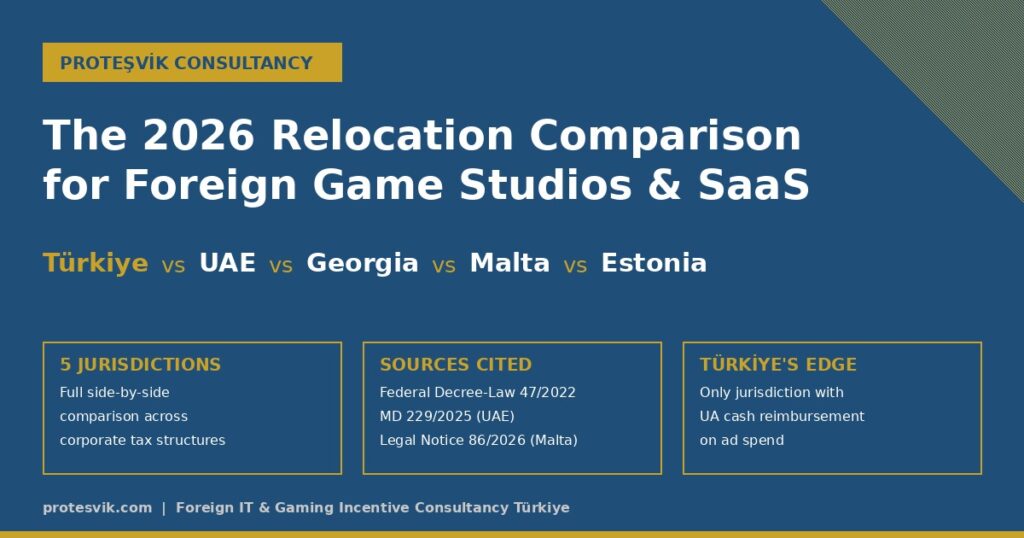
- The Türkiye vs UAE Georgia Malta Estonia comparison covers the five jurisdictions foreign mobile game studios and SaaS companies most often shortlist for international expansion.
- Türkiye’s distinguishing feature is the combined application of cash reimbursement under Presidential Decree No. 10962 and the 100% profit deduction under Article 10/1-(g) of the Corporate Tax Code.
- The other four jurisdictions offer tax relief only; Türkiye is the only jurisdiction that provides direct cash reimbursement on digital marketing spend.
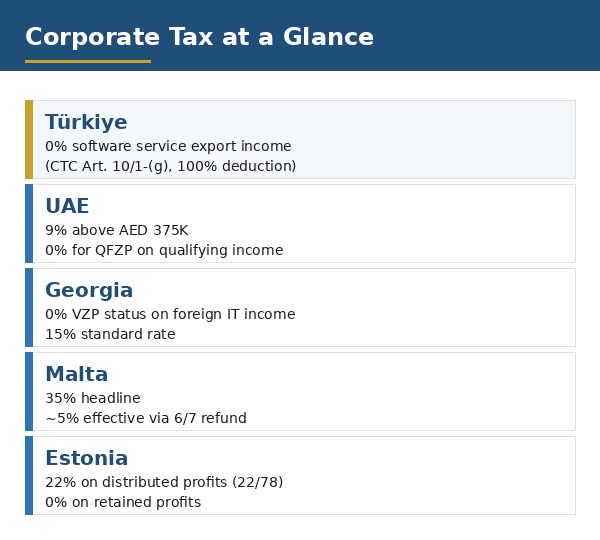
- UAE applies 9% corporate tax above AED 375,000; 0% is available for Qualifying Free Zone Persons (QFZP) but subject to five conditions under Federal Decree-Law 47/2022.
- Georgia’s Virtual Zone Person (VZP) status delivers 0% on foreign-sourced IT income; the standard rate is 15%, with 5% dividend tax on distribution and 20% payroll withholding.
- Malta’s 6/7 shareholder refund reduces the effective rate to ~5%; the regime is designed for licensed iGaming operators.
- Estonia applies 22% corporate tax on distributed profits (22/78 formula); accrual is deferred on retained profits.
- Newly incorporated foreign-owned Turkish companies are exempt from the domestic minimum corporate tax during their first three accounting periods (CTC Art. 32/C-5).
Introduction
A foreign game studio Türkiye decision is rarely made in isolation — the shortlist typically expands into Türkiye vs UAE Georgia Malta Estonia. Each of the five jurisdictions offers a different structural advantage, and each has limitations that only surface after detailed diligence.
This article places the five jurisdictions side by side and looks at where each one actually wins and which business model each fits. For a full analysis of Türkiye’s incentive framework, see our Foreign IT & Gaming pillar guide. For the mechanics of setting up a foreign-owned Turkish company, see our Foreign-Owned Turkish LLC or JSC Setup Guide.
Abbreviations Used in This Article
The following abbreviations recur throughout the comparison and are summarised here for reference.
- QFZP (Qualifying Free Zone Person): the compliance status required for a UAE free zone company to apply 0% corporate tax
- VZP (Virtual Zone Person): the status that delivers 0% corporate tax on foreign-sourced IT service income in Georgia
- MGA (Malta Gaming Authority): Malta’s regulatory authority for gaming licensing
- DMTT (Domestic Minimum Top-up Tax): the 15% global minimum corporate tax mechanism under OECD Pillar Two
- CFC (Controlled Foreign Company): the rule set under which a founder’s home country can tax profits held in a foreign subsidiary
- CIT (Corporate Income Tax)
- DYS (Support Management System, Türkiye): the electronic portal through which Türkiye’s Ministry of Trade administers incentive applications
- HİB (Services Exporters’ Association, Türkiye): the exporters’ association for services exporters based in Türkiye
Türkiye vs UAE Georgia Malta Estonia: The Five-Jurisdiction Comparison Table
The table below places the key parameters of the five jurisdictions side by side. Figures reflect legislation in force as of July 2026 and should be considered together with local counsel.
| Factor | Türkiye | UAE | Georgia | Malta | Estonia |
|---|---|---|---|---|---|
| Headline corporate tax | 25% (CTC Art. 32/1); 0% on software service export income via 100% deduction under CTC Art. 10/1-(g) | 9% above AED 375K; 0% for QFZP on qualifying income | 15% standard; 0% for VZP on foreign-sourced IT income | 35% headline; ~5% effective via 6/7 shareholder refund on trading income | 22% on distributed profits; deferred accrual on retained profits |
| Direct cash incentives | Yes — under Presidential Decree No. 10962: digital promotion, commission, personnel, software licensing, database membership support | No | No | No | No |
| EU market access | Not an EU member; strong EU link via 1996 Customs Union | Non-EU; strong MENA reach | EU Association Agreement and DCFTA; not an EU member | Full EU member | Full EU member |
| Setup timeline | 2-4 weeks total (LLC registration 24-72 hours, incentive registration additional) | Company registration fast; QFZP compliance is ongoing | LLC 1-2 days; VZP application 10 working days | 2-3 weeks for company plus MGA licensing | Online (e-Residency) or classic; generally fast |
| Regulatory complexity ahead | Predictable after registration; incentive renewal is process-driven | Rising: CT is new; Ministerial Decision 229/2025 and Pillar Two DMTT pressure for larger groups | Low; but local personnel and substance requirements tightened in recent years | Increasing: Malta VAT and gaming framework revised via Legal Notice 86/2026 in 2026 | Predictable; but the founder’s home-country CFC and permanent establishment rules require attention |
Where Türkiye Wins for a Foreign Game Studio
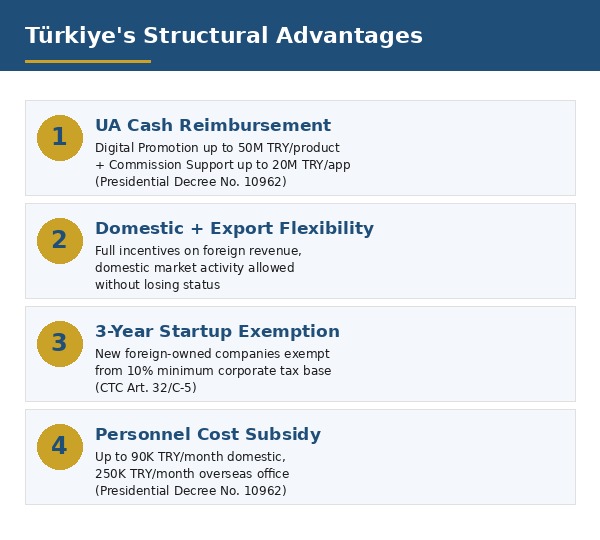
Within the Türkiye vs UAE Georgia Malta Estonia comparison, Türkiye distinguishes itself along four structural lines.
Cash Reimbursement for User Acquisition-Heavy Business Models
This is the single most defining structural difference in the comparison. UAE, Georgia, Malta and Estonia all offer a lower tax bill. None of them, however, reimburses a portion of your Google Ads, Meta, TikTok or Apple Search Ads spend. Türkiye’s Takeoff Program under Presidential Decree No. 10962 is the only jurisdiction that does — and it is not a single-item program. It offers a framework of multiple support items applied together: Digital Product Promotion Support (annual ceiling of 50 million TRY per product), Commission Support (annual ceiling of 20 million TRY per app targeting App Store and Google Play platform commissions), Marketing Personnel Support, Software Licensing Support, Database Membership Support, and brand development supports under the e-Turquality (Champions of IT) program.
These support items are applied alongside the 100% profit deduction under CTC Art. 10/1-(g) and are combined in different mixes depending on the mobile game or SaaS company’s cost structure. For a mobile game publisher or SaaS company whose largest cost line is marketing, this two-layer structure (tax relief combined with cash reimbursement) is a structural advantage that the other four jurisdictions do not offer. For a full breakdown of all support items under the Takeoff Program and e-Turquality, see our Foreign IT & Gaming pillar guide. The support ceilings are revised upward each year by the Ministry of Trade on the basis of the official revaluation rate; the figures above reflect the 2026 ceilings.
Incentive Access Without Giving Up Domestic Market Presence
Georgia’s VZP status only applies to income earned from clients outside Georgia. A company that also wants a domestic footprint loses the status advantage. Türkiye’s incentive framework, on the other hand, is built around export activity. A foreign publisher that also wants to sell in the Turkish market can still benefit from full incentive treatment on foreign-sourced income and manage domestic revenue under the standard rate. Among the five jurisdictions, this flexibility exists only in Türkiye.
Three-Year Startup Exemption from the Minimum Corporate Tax
Under CTC Art. 32/C-5, companies newly established in Türkiye are exempt from the 10% domestic minimum corporate tax base during their first three accounting periods. The Turkish Revenue Administration’s 2026 Domestic Minimum Corporate Tax Guide expressly confirms this. A newly incorporated foreign-owned Turkish company can therefore benefit fully from the 100% deduction under CTC Art. 10/1-(g) during its first three years and achieve an effective 0% corporate tax profile.
This three-year window applies only to companies established from scratch. Entities formed through merger, transfer, conversion, partial demerger or full demerger are subject to the minimum tax from day one. For the full 2026 tax map, see our Mobile Gaming Tax Map 2026 Q3.
Direct Subsidy on Personnel Cost Structure
Georgia’s developer salaries have risen materially as the ecosystem matured, and what used to be its clearest cost advantage has narrowed. Türkiye offers a developer talent pool of similar technical strength but with a different cost-value balance. On top of that, the Marketing Personnel Support under Presidential Decree No. 10962 reimburses up to 90,000 TRY per month for domestic personnel and up to 250,000 TRY per month for personnel in overseas offices.
This is a mechanism that offsets hiring cost directly rather than lowering the corporate tax rate. For details on the personnel subsidy alongside the current tax regime under Law No. 7582, see our Türkiye Tax Reform guide.
Where the Other Jurisdictions Win
UAE: Holding Structures and MENA Reach
UAE is a strong option for companies whose priority is a globally recognised business address, holding-company structuring or MENA market access. However, the 0% corporate tax rate is not automatic. It applies only to the qualifying income of a QFZP, and there is a threshold on non-qualifying revenue (de minimis: the lower of 5% of revenue or AED 5 million). The regime is still maturing, and Ministerial Decision 229/2025 has updated the qualifying activities list.
Since 2025, the 15% Domestic Minimum Top-up Tax (DMTT) under OECD Pillar Two applies to multinational groups with global consolidated revenue above EUR 750 million (Cabinet Decision 142/2024). For a lean mobile game studio, the UAE’s tax advantage may in practice be smaller than the headline “0% free zone” narrative suggests.
Georgia: Speed and Simplicity
Georgia is the most attractive option in the comparison in terms of raw speed and cost for a very early-stage team. The company is registered within days and VZP status delivers a 0% corporate tax rate on export income (Law on IT Zones, 2011).
The trade-offs are clear: there is no direct cash incentive, no personnel subsidy, and 100% of your revenue needs to come from outside Georgia. There is also a 5% dividend tax on distribution and 20% withholding on salaries. The headline “0%” does not cover these. Local qualified IT personnel employment is now a tightened requirement, and a setup that fails substance conditions can lose the status.
Malta: For Licensed iGaming
In the comparison, Malta is the correct answer for iGaming operators. The 6/7 shareholder refund mechanism and the MGA licence deliver real value in that context. The Malta regime is not designed for a mobile game studio publishing on the App Store and Google Play, or for a SaaS company.
Recent regulatory developments should be considered: Malta’s VAT and gaming tax framework was revised via Legal Notice 86/2026 in 2026. It should also be noted that a Malta iGaming licence does not provide automatic EU-wide passporting; each EU Member State applies its own regulation.
Estonia: The Profit Deferral Model
Estonia’s model ties corporate income tax to profit distribution. Accrual is deferred on retained profits; when profits are distributed, 22% corporate income tax applies (22/78 formula). In December 2025, the previously planned increase to 24% was cancelled by Parliament, and the rate remains at 22%.
For a SaaS company that retains earnings and reinvests in growth, this structure defers the tax burden over time. However, for an advertising-heavy mobile game model, Estonia does not offer the same type of advantage as Türkiye’s cash incentive framework. In addition, the founder’s home-country CFC rules can tax retained profits held in Estonia at the local level, and permanent establishment risks may limit Estonia’s advantage when all management and business activity is conducted from another country. The e-Residency program provides registration convenience but does not confer tax residency.
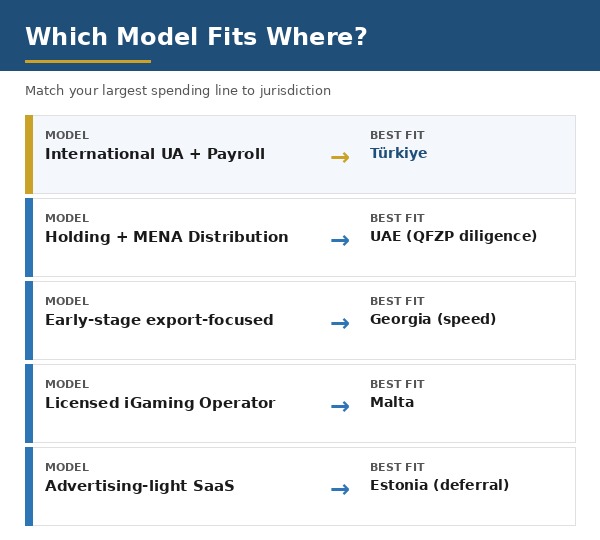
Decision Framework: Türkiye vs UAE Georgia Malta Estonia — Which Business Model Fits Where?
Instead of asking which country has the lowest tax rate, the more useful question is: what is the largest spending line in your business? Each jurisdiction maps to a different cost structure.
For business models where international UA and advertising spend combines with payroll, Türkiye’s framework is the only one in the list; it has the mechanism to reimburse both sides. For firms focused on holding-company structuring and MENA distribution, UAE is a fit with realistic QFZP compliance diligence. For very small, fully export-focused early-stage teams, Georgia stands out on speed and simplicity. For licensed iGaming, Malta is the only option in the comparison. For advertising-light SaaS models that retain and reinvest profits, Estonia can be evaluated for its deferral structure.
Most companies do not select a single jurisdiction for their entire business anyway. Layered structures are common: a Turkish entity for export operations and UA-heavy activity, while IP or investment structures are held elsewhere. This type of design should be mapped out with an advisor before committing to a single jurisdiction.
Turkish Company Setup Mechanics for Foreign Investors
Under Foreign Direct Investment Law No. 4875, foreign natural or legal persons in Türkiye have equal rights with domestic investors. 100% foreign ownership is possible and there is no local partner requirement.
The minimum share capital for a limited liability company is 50,000 TRY, with no pre-registration bank blocking required. The minimum for a joint stock company is 250,000 TRY, with 25% cash blocking required under TCC Art. 344. Once documentation is complete, Trade Registry filing is completed within 24-72 hours; the realistic total process takes 2-4 weeks. For the full mechanics of Turkish company setup, see our Foreign-Owned Turkish LLC or JSC Setup Guide.
Frequently Asked Questions
Is Türkiye’s cash incentive genuinely different from the other jurisdictions in this comparison?
Yes. Among the five jurisdictions compared, only Türkiye reimburses a portion of digital marketing spend directly. UAE, Georgia, Malta and Estonia offer tax efficiency but do not return any part of Google Ads, Meta, TikTok or Apple Search Ads spend in cash. Under Presidential Decree No. 10962, the Takeoff Program includes Digital Product Promotion Support with an annual ceiling of 50 million TRY per product; commission, personnel, software licensing and database membership support items are also available. These figures reflect the 2026 ceilings and are revised upward each year by the Ministry of Trade on the basis of the official revaluation rate. For a comprehensive analysis of how foreign IT and gaming firms can benefit from the incentive ecosystem, see our Foreign IT & Gaming pillar guide.
What advantages do newly established foreign-owned Turkish companies enjoy in their first three years?
Under CTC Art. 32/C-5, companies newly established for the first time are exempt from the 10% domestic minimum corporate tax base during their first three accounting periods. Combined with the 100% profit deduction on software service export income under CTC Art. 10/1-(g), a newly incorporated foreign-owned Turkish company can achieve an effective 0% corporate tax profile on foreign-sourced software income during its first three years. This three-year window applies only to companies established from scratch. For this and other critical details of the 2026 tax map, see our Mobile Gaming Tax Map 2026 Q3.
What are the prerequisites for accessing Türkiye’s export incentives?
Access to Takeoff Program supports under Presidential Decree No. 10962 requires membership in the Services Exporters’ Association (HİB) and registration in the Support Management System (DYS). These prerequisites are the foundation of incentive eligibility; correct NACE code selection and company setup structure are also decisive in the incentive approval process. For a detailed review of prerequisites and support items, see our Türkiye Tax Reform guide.
Does it make sense to use Türkiye and UAE together?
In some cases, yes. Layered structures are common: a Turkish entity for UA-heavy operational activity and a UAE holding company for IP or regional investment structuring. This type of structure requires significant tax and regulatory planning and must be evaluated separately for each firm. For Türkiye’s positioning within layered structures, see our Foreign-Owned Turkish LLC or JSC Setup Guide.
Why should AI-focused companies consider Türkiye in this comparison?
Türkiye’s Software Licensing Support (annual ceiling of 2,500,000 TRY) and Database Membership Support (annual ceiling of 2,500,000 TRY) under Presidential Decree No. 10962 directly reimburse AI companies’ spend on OpenAI, Anthropic API, AWS, GPU compute and ML platforms. This is a structure that is not available in any of the alternative jurisdictions. For details on how AI-focused companies benefit from Türkiye’s incentive framework, see our Foreign AI Companies guide.
How Proteşvik Helps a Foreign Game Studio Türkiye Entry
Proteşvik’s core area of work is Türkiye’s export incentive ecosystem: the Takeoff Program under Presidential Decree No. 10962, the e-Turquality program, TÜBİTAK support programs and related incentive items. In the Türkiye vs UAE Georgia Malta Estonia comparison, our services for positioning Türkiye correctly include:
- Modelling Türkiye’s incentive framework against the firm’s specific business model
- Side-by-side financial comparison with UAE, Georgia, Malta and Estonia alternatives
- Incentive-driven Turkish company setup structuring and NACE code selection
- Preparation and process management of Takeoff Program and e-Turquality applications
- Technology Development Zone placement and assessment of CTC Art. 10/1-(g) application conditions
- DYS activation and HİB membership
- Positioning of the Turkish entity within layered jurisdiction structures
With more than 15 years of field experience, we position Türkiye correctly within jurisdiction comparisons and ensure that foreign IT and gaming companies capture the highest net benefit.
Official references: Official Gazette, Ministry of Trade, Turkish Revenue Administration, Ministry of Industry and Technology, Invest in Türkiye.
Assess Your Türkiye Potential
A 30-minute free feasibility assessment will clarify a side-by-side comparison between your mobile game or SaaS company under Türkiye’s incentive framework and the alternatives (UAE, Georgia, Malta, Estonia). A concrete structural recommendation is provided based on your firm’s advertising spend, payroll and business model.
📞 +90 (530) 160 10 65 | ✉️ [email protected] | 💬 WhatsApp